
Taipei 101
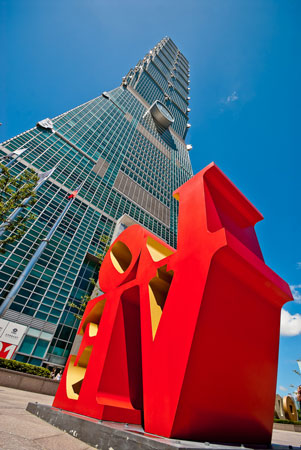 No longer the world’s tallest completed structure — since 2010 that honour has gone to Burj Khalifa in Dubai — Taipei 101 in Xinyi District is still a major shopping-and-sightseeing attraction. Its 101 floors tower over the capital and serve as a useful landmark for those navigating the city on foot.
Some 509 m (1,671 ft tall), including antennas, Taipei 101 was designed by C.Y. Lee, one of Taiwan’s most notable architects. Lee has described how his concept was inspired by the shape of bamboo, which not only grows well across Taiwan, but is also a symbol of longevity and resilience throughout the Chinese world. In Taiwan, the principles of fengshui are very often taken in account when buildings are laid out, and Taipei 101 was no exception, hence the large motifs on the sides of the tower. More importantly, perhaps, the building — which weighs 700,000 metric tons — was engineered to withstand the strong earthquakes and powerful typhoons which sometimes strike the island.
Naturally, the tower is a highly prestigious address. Accordingly, most of the building is given over to company offices. Taipei’s stock exchange occupies floors 9 to 12; Google, L’Oreal Taiwan, and various banks have a presence. Taipei 101 Mall, which is in an adjoining building rather than the tower itself, has luxury-goods outlets as well as several good dining options.
The Observatory is one of Taipei’s pricier attractions (adults pay US$20, children only slightly less; with advance planning, it’s often possible to get a discount). However, if the weather is good the views are worth every penny: To the north one can see the Keelung River and the suburb of Neihu; in the distance, the peaks of Yangmingshan National Park are visible. Nearer hills lie to the east, where Elephant Mountain, a very popular hiking spot, is just 2.4 km (1.5 miles) away. To the west, Chiang Kai-shek Memorial Hall is easy to make out. Often, the most stirring sight is the ridge of high mountains to the south. This is the Central Mountain Range, the massif which runs almost the entire length of the island.